
Projects Overview
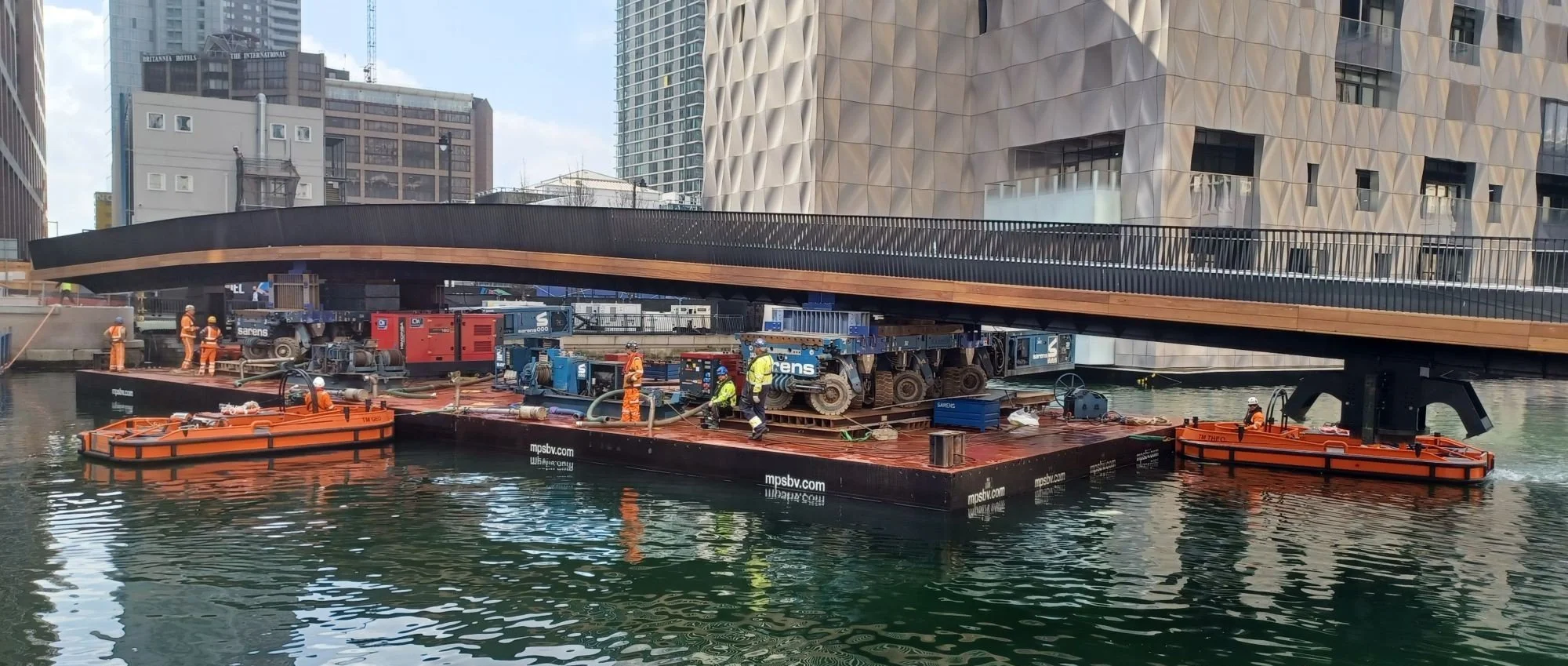
Bridge Installation Canary Wharf
Three work boats were supplied with operators to our client to assist with a challenging project to install a bridge in the middle dock at Canary Wharf. A 60m long steel bridge was loaded onto a 30m long modular barge using SMTP’s. Taska Marine supplied three road transportable work boats, the Challis 10, TM Theo and TM Geo to move the modular barge into position so the main contractor could install the bridge. Due to the barge having 15m of over hanging bridge at either end, it was decided to utilise the Challis 10, a 250hp tug supported by our two shallow draft 602 work boats, Theo and Geo to ensure full control of the barge at all times given the unpredictable wind gusts at Canary Wharf.
The 602 workboats were built in house and specifically designed for supporting inland marine construction projects. Powered by stage V Kubota engines and hydraulically driven, they have very low air and water drafts allowing them to work in shallow water and pass under structures less than 1m above the surface of the water.
The barge and bridge was successfully moved from its mobilisation location to its installation position to allow the barge to be ballasted and the bridge installed on its foundations. After installation the ballasted barge was moved out from under the bridge and moved back to the quay edge for demobilisation
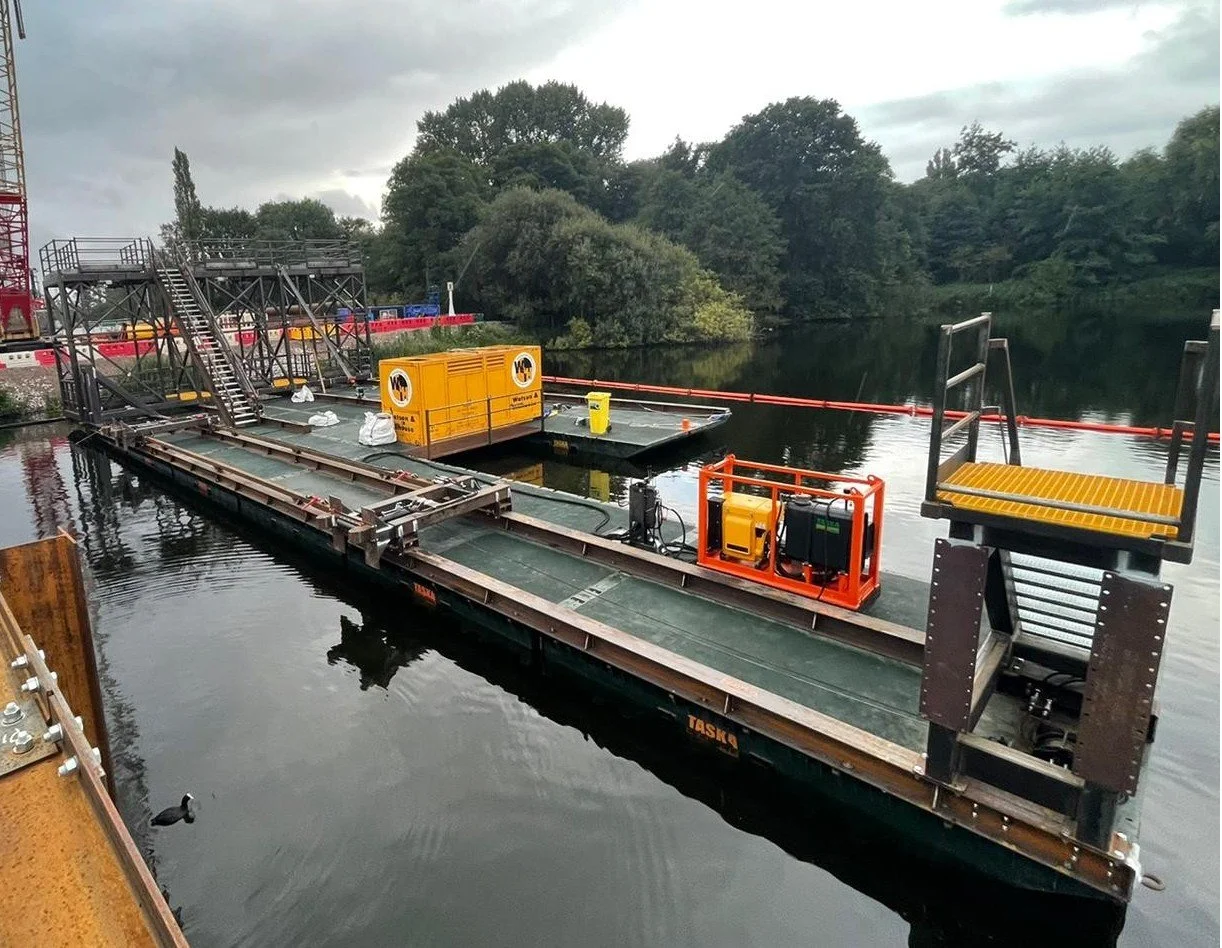
Modular floating piling gate platform
Taska Marine designed, fabricated and mobilised a modular floating piling gate to support the works on the Colne Valley Viaduct temporary jetty for our client on the HS2 project.
The viaduct spans 7 different bodies of water and the depth was less than 1m in places so a temporary jetty was installed to provide access to construct the piers. A floating gate was required to install the piles that would form the foundations for the working platforms for constructing the piers. The longest piles were 42m in length and 800mm dia, the client wanted to set and drive up to three piles at a time before moving the barge away and into position for the next set of piles.
The 18t cantilevered sectional piling gate, 34 pontoons and positioning system was designed by Taska Marine to be a comprehensive system for our client, that would be modular, road transportable, open fronted, shallow draft and reversible. Spud legs could not be used due to the risk of damaging the underlying chalk aquifer so a hydraulic positioning system and winches were designed and fabricated in house, to move and hold the floating platform in position during piling operations.
A full stability package was provided to demonstrate the pontoon stability during assembly and throughout all stages of the piling installation works
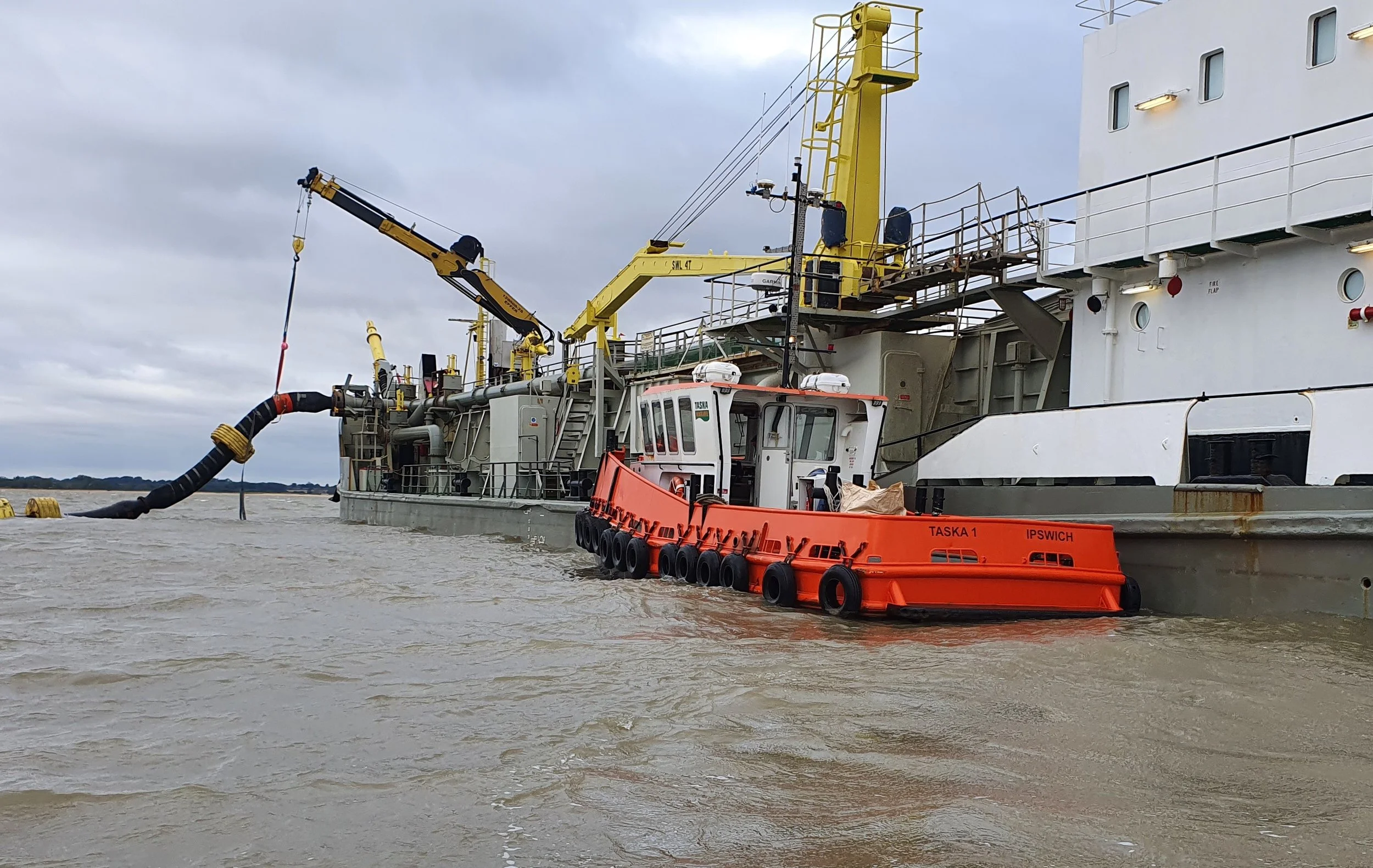
Dredging Support Craft on East Coast
Taska Marine supplied the vessels to support clients on the Beneficial Use of Dredged Sediment (BUDS) project on the East coast of the UK. The Taska 1204 and a 5m shallow draft aluminium dory were supplied with crews covering works throughout the winter. Works progressed 24/7 and were carried out from October to the middle of January.
Ballast was dredged by our client as part of their dredging contract for the deepening of the Harwich and Felixstowe approach channel and reused to replenish four areas where erosion had damaged local wildlife habitats.
The Taska 1204 work boat supported the clients multicat on site in moving and repositioning the floating discharge pipe on every tide in the shallow waters that the multicat could not work in. The aluminium dory and crew repositioned the mooring lines to anchor the pipe in place during the discharge and provide access onto land so anchors and ropes could be prepared for the following discharge. In total approximately 50,000 m3 of material was placed which will allow the natural processes to redistribute the material along the coast.
