
Frequently asked questions
What type of marine equipment do i need to hire?
Chartering or renting marine equipment, such as work boats, safety boats and pontoons when working over water can be a cost-effective way to access the equipment you need for a specific project, without having to purchase it outright.
Equipment can be hired under standard CPA agreements, as used on most civil engineering projects or under BIMCO marine contracts which are more detailed and complex but cover a greater range of issues that may arise especially if vessels may be used in different jurisdictions.
Taska Marine’s work boats, safety boats and modular pontoons can be hired and supplied anywhere in the UK, for projects nearshore, tidal, estuarine or on inland waterways
Work boats
Which type of boat do i need?
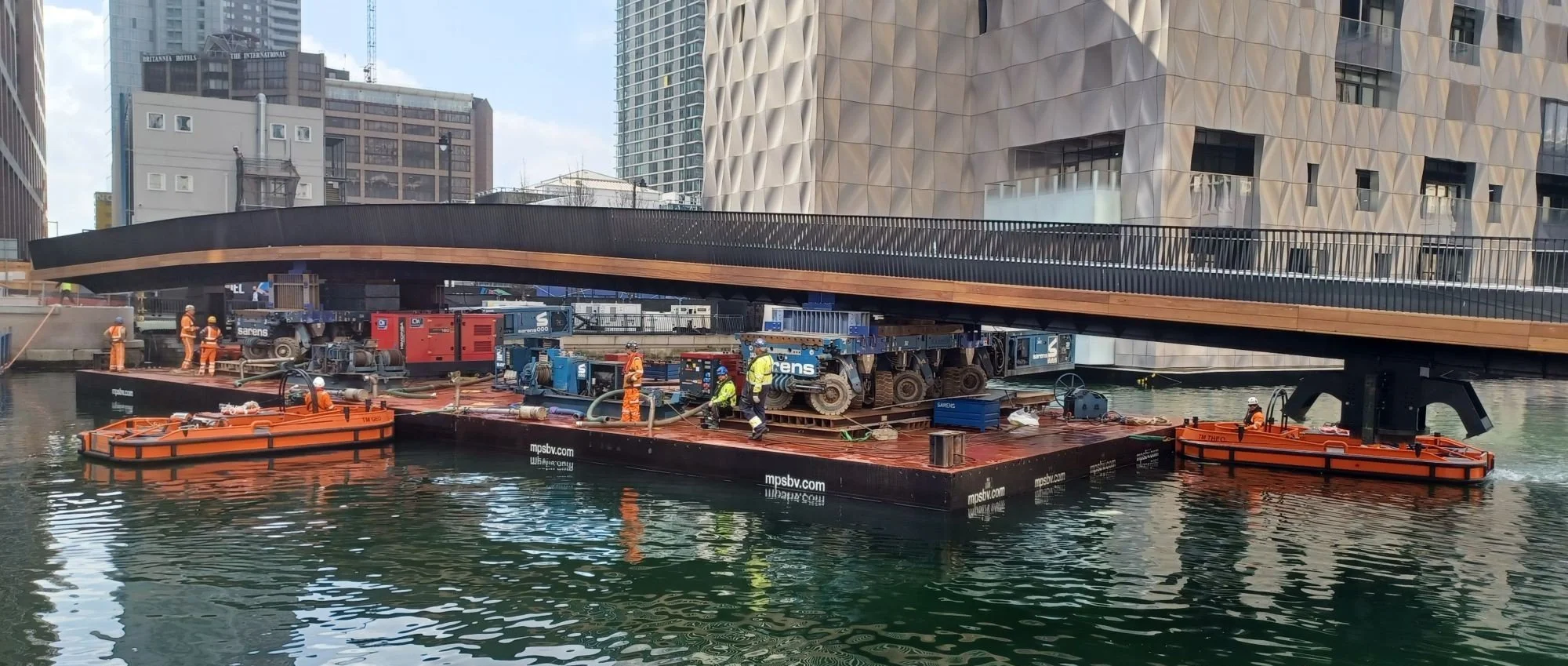
Work boats are designed for use in marine environments to carry out specific tasks. They can be used for a variety of purposes, such as personnel transfer, logistics, safety or survey works and are available in a range of sizes and types, so it is important to choose the right one for your project.
Whether your scheme is a large marine construction project or just a site that has an element of water, the primary question should always be, “What will the work boat actually be doing?” The answer to this question may be simple or could be complex on a larger scale project.
Some other issues to consider are;
Are there width or operational restrictions on the project?
Are you working in restricted water depths, do you need a shallow draft vessel?
Do you need a vessel with a low air draft to get under specific structures?
Does the workboat require space on deck for cargo or personnel?
Do you need any alterations or modifications on the work boat for specific tasks on the project?
Where is the project?
The various types of location such as coastal, nearshore, estuarine, inland waterways, lakes and reservoirs all have different considerations and potential issues. The tidal range of a location in the UK may alter anywhere from 2m-14m depending on where the project is located. Where there is a greater tidal range, there are normally strong tidal flows which may require a larger vessel.
The location may fall under Categorised waters as defined by the MCA or there may be additional local issues and regulations to consider. Access to the water will also dictate how the workboat will get mobilised to site, typically it will be transported by road direct to site or another nearby location so that it can be taken to the working location by water.
What size of work boat is required?
Boats don’t need a huge amount of power to move heavy objects on water, but a lot of power may be needed to stop something once it is moving. If the workboat will be used to move other equipment around, consideration should be given to the weight, depth and height of the pontoon as well as the proximity of nearby objects and fixed structures. In some locations, it may be a better option to have two smaller workboats to give more control during maneuvering to minimise any risks.
Work boats with higher power ratings may be necessary when looking at working in locations with strong currents or in exposed conditions where windage could be an issue. An important factor with larger vessels will be fuel efficiency, as bigger boats with more engines will typically use more fuel.
What is the best type of propulsion for work boats?
Work boats can be supplied with a variety of propulsion systems. Common systems include outboard engines which attach to the outside of the hull, traditional single propellor (single screw) with an inboard engine, twin propellors (twin screw) with either one or two inboard engines or 360degree rotating drive units with inboard engines. Outboard engines will be petrol or electric whereas virtually all inboard engines will operate on diesel or HVO.
For each of the different types of propulsion there are advantages and disadvantages, some boats will have better maneuverability than others or some will be more stable in a straight line when moving barges longer distances
What are the requirements for personnel on the project?
Work boats will have limits as to how many people can safely be onboard at the same time, to ensure that there are sufficient lifesaving appliances onboard in the unlikely event of an incident occurring. If vessels are being used to transfer personnel then consideration should be given to the suitability of the access and egress from the workboat to the structure or the other vessel.
Do you require the workboat to be supplied with or without crew?
How many people are required to be onboard including the crew?
Are there access and egress issues?
Want to know more about work boats? - Get in touch for a no obligation chat - 01473 226344
Modular pontoons
What are modular pontoons?
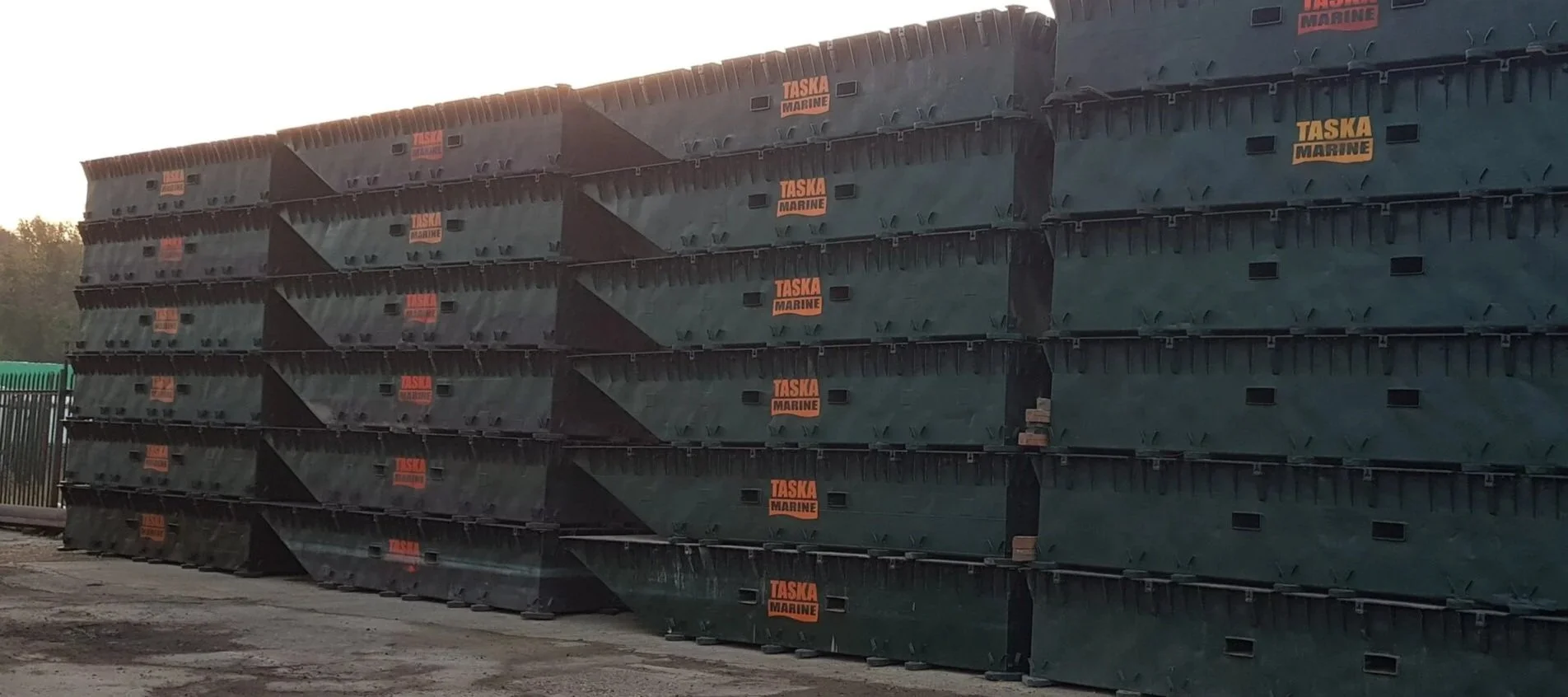
There are many different terms that are used to describe modular pontoons which are used across the industry. Modular pontoons, nato pontoons, floats, modular barge or floating work platforms are all relatively interchangeable descriptions of the same thing, a floating platform assembled from more than one part, used to work on or from. In the construction industry the most common and robust type of modular pontoons are made from steel
What are the advantages of using modular pontoons?
It can be cost effective to use modular pontoons as they can be configured to suit your specific project requirements and altered as the project develops. If there are restrictions on getting bigger barges to the site location then barges constructed from modular pontoons can be an alternative solution.
Working on pontoons?
There are several major differences between working on pontoons or on land. Apart from the increased hazards such as working over water, the main differences are that the pontoon can move position and the deck which may start off level, can and will change. Any external forces applied to the pontoon will cause it to alter position, rotate, lean or tilt, all of which may have an impact on the overall stability during operations.
Floating platforms can be used for a wide variety of purposes, such as providing access over water, logistics, equipment storage and creating temporary walkways. Pontoons are also available in a range of sizes and materials, so it is important to choose the right type for your needs.
Things to consider when choosing a pontoon layout?
Where is the project located?
Projects can be in various types of location such as coastal, nearshore, estuarine, inland waterways, lakes and reservoirs, which all have different potential issues. The location may also have additional site specific considerations such as when working adjacent to weirs or lock structures. Some locations may not be suitable or may require a different approach, but if there is enough water to float, then modular pontoons could be an effective solution.
Are there any potential environmental impacts?
When working on any scheme over water the risks of environmental pollution, contamination and habitat disruption are all increased and one way to mitigate these risks is by selecting well maintained suitable equipment.
Most over water schemes will require some form of licencing or permits to carry out the works. Whether it is an MMO licence or similar for working in or over tidal waters or a river works licence from a local navigation authority, environmental issues are taken very seriously and additional constraints could be imposed on contractors. These licences may impose strict conditions, such as restricting the use of hydraulics or certain fuel types when operating in highly sensitive sites such as drinking water reservoirs or preventing the use of spudlegs or anchors to prevent river or sea bed damage.
Do I need to make allowances for any weather conditions?
The main issues when considering the weather will be; exposure to the wind on the site, the possibility of rain increasing water flows, flooding events, or alterations to the predicted tides caused by changes in atmospheric pressure. Authorities that manage inland rivers and canals may impose operational restrictions during periods of higher water levels to protect users. Over the winter months there is also an increased risk of flooding or extended periods of high water levels which may cause project delays.
What is the deck capacity of pontoons?
Static and dynamic loads both need to be looked at when calculating the pontoon deck capacity for a project. Everything needs to be taken into account including any dynamic loads that may be imposed by machinery working on the deck. When compiling a list of items and weights that will go onto the pontoon, don’t forget to make allowances for the miscellaneous smaller items and personnel, its better to err on the side of caution to start with. This initial list may change as the project develops but as a starting point it will often dictate the approximate barge dimensions that will be required. Correct planning and analysis should avoid the pontoon from becoming overloaded or potentially unstable due to incorrectly positioned loads.
What is the difference between point and deck loads on pontoons?
The decks of the pontoons are designed with a maximum point load, often referred to as a maximum load per square metre. Point loads shouldn’t be confused with maximum deck loads, point loads refer to the localised deck strength whereas maximum deck loads refer to maximum safe load for the pontoon. Higher point loads can be accommodated but require some form of additional matting to spread the loads over a greater deck area. Deck protection may also be required when operating some types of machinery on the pontoon to avoid damage to the pontoon and reduce the risk of any issues when off hiring the equipment
What is floating stability?
Floating stability can have a major impact on the design and layout of a pontoon setup. There are two main types of primary loading to consider, static and dynamic, although other factors such as environmental conditions can play an important role. Static loads are placed on the pontoon in a fixed position and do not move, a dynamic load may be something that moves around the deck or a load that alters during the works such as fluid transfers.
Stability can initially be checked by carrying out a desktop analysis of the pontoon with various assumed load cases and secondly once the pontoon has been assembled and loaded a physical check can be made to ensure that the desk top analysis is correct. The results of the initial desk top analysis may cause the barge layout to be adapted to ensure stability can be maintained throughout the works.
How should I plan the deck layout on the pontoon?
When planning deck layouts, sufficient space should always be allowed around fixed deck items for clear unobstructed walkways and to provide safe access routes. Working areas for machinery should be clearly designated and ideally access should be restricted with barriers but on small pontoon setups this may not be possible in all cases.
Deck plans should be produced to illustrate the correct positioning of loads on the platform and ensure that any stability calculations will be as accurate as possible.
What accessories are available for the pontoons?
There are various additional accessories that may be required on a project and some of the nautical terms you may not be familiar with.
The pontoon can be held in position using spud legs which are typically large metal tubes used for holding position. Spud legs are inserted through spud wells, which are holes through the deck or supplied as attachments that can be fitted to the outside edges of the pontoons. Spud legs can be lifted with a winch system, deck mounted crane or another item of plant on the pontoon such as an excavator.
Alternatively the pontoon be held in position using ropes or winches depending on the location and water depth. Winch options may be determined by the operating location or due to noise constraints and can be operated by pneumatic, hydraulic or manual options
Mooring bollards are used to tie up the pontoon to another structure or can be used when pushing or towing to attach the pontoon to a workboat.
Fendering may be required to prevent damage to an adjacent structure or vessel or simply to prevent the pontoon from getting caught when moored up, mainly when operating in tidal waters
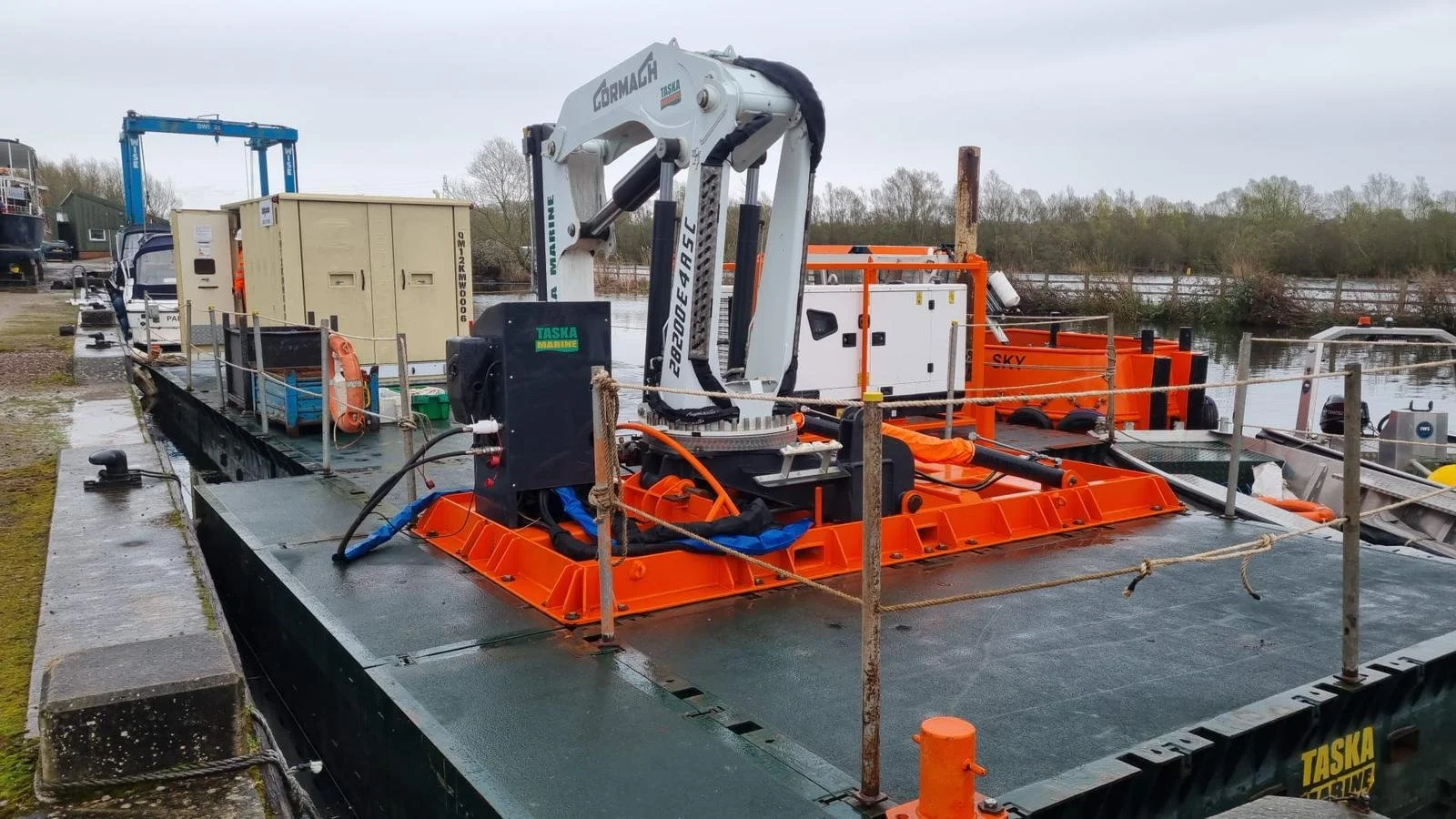
Deck mounted cranes can be fitted to the pontoon setup to provide lifting capabilities over water. They can be supplied in a variety of sizes and are bolted directly to the pontoon. The size required and final position will typically be calculated with the desktop analysis of the pontoon setup. The deck mounted cranes are normally powered by a diesel-hydraulic powerpack but can be used with suitable electric-hydraulic powerpacks.
Items placed on the pontoon may require sea fastening or restraints fitted to prevent unwanted movement. Sea fastening can be as simple as securing items with ratchet straps or require custom fabricated restraint systems for items such as tubular steel piles or concrete reinforcing cages. These items should be prevented from being able to roll or move on deck which may cause the pontoon to become unstable. The working location will have an impact on what type of fastenings are required and what forces they may have to be able to withstand
Want to know more about pontoons? - Get in touch for a no obligation chat - 01473 226344
Can marine equipment be used for events and promotions?
Marine equipment can be used for a variety of events, both short-term and long-term. For example, workboats and pontoons can be used to provide transportation and logistics support or pontoons used to create temporary platforms or walkways. Art and accessories such as lighting and sound systems can be placed on pontoons to enhance the event experience.
Here are some specific examples of how marine equipment can be used for events:
Filming: Pontoons can be used to provide a floating base for a film set, or they can be used to create temporary walkways and platforms for actors and crew.
Music festivals: Pontoons can be used to create temporary stages, dance floors, access bridges across rivers and lakes.
Corporate events: Pontoons can be used to create temporary meeting spaces, dining areas or promotional spaces.
Promotional spaces: Modular pontoons can be assembled on lakes in high profile locations for product promotions and advertising
Support or safety boats can be supplied across all events
When choosing marine equipment for an event, it is important to consider the specifics such as the size, location and the type of activities that will be taking place. It is also important to choose the right marine plant hire company that can provide the best equipment for the job and that can meet the safety and security requirements of the event.
